下载App
资质规则
旅行
账户
ellimic2016
A fantastic day
The Historic Dockyard Chatham的点评
点评:Today I went to the Chatham Historic Dockyard.
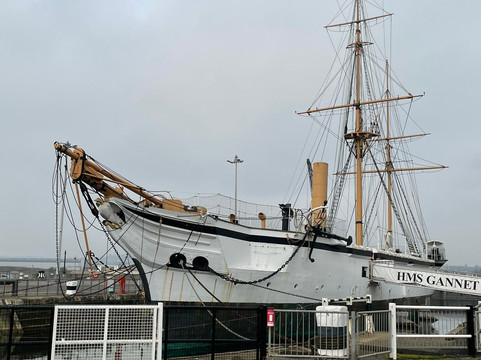
Docked in Chatham as a permanent Museum exhibit since 1987 is HMS Gannet and the real reason I came today
The ship was amazing to see, a beautiful ship (the last surviving Doterel-class screw-driven sloop of the Victorian Navy)
Something about the ship did not look right to me though, a barque with only two masts is vet wrong, as well as having a rather shortened Spritboom.
There was a member of staff on board, and when I asked him about the ship he said ”I’m glad someone has finally noticed!”
He expalined that the foremast had been removed for restoration, pointing to where it had been laid down and partially covered under a tarpaulin further down the dock.
Also he said that the Spritboom had been retracted onto the bow for the same purpose.
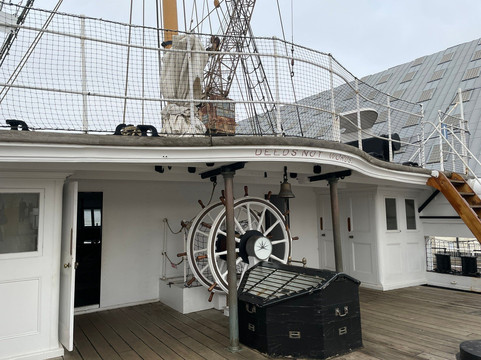
It was still amazing to walk around the weather deck of the ship with the two remaining masts, the rigging and the steam funnels.
At the fore of the ship were stairs up to the fo’clse looking over the bowsprit.
Beneath the fo’csle is a storage room containing a single 64 pound cannon, an example of one of the armaments she carried.
At the aft were siimilar stairs to the poop deck (presumably this is a poop rather than a quaterdeck, as I believe that what makes a quarterdeck a quarterdeck is the presence of the ships wheel, which was located below. Any deck above the ships’ wheel therefore must be the poop?)
Under the poop deck was a large room (a great cabin), which presumably was for the captain of the ship.
Returning to the fore, there was a staircase behind the capstan going to the lower deck.
These stairs went down to a small room, about the same size as the fo’csle.
Besides plenty of information boards, there was practically nothing else here, and moving aft along a walkway on the starboard side, the steam pump machinery has been removed leaving a big empty space.
Beyond this was another room, equally devoid of everything except a few information boards and a staircase back up to the weather deck.
All the stairs on the ship were incredibly steep, almost vertical, and the steps were very narrow, so I took all of them very slowly and carefully. There were notices everywhere on the steps saying to go down facing the steps.
In HMS Victory I haddn’t followed this ruling as I cannot say it felt safe having my back to an empty room, if I fell backwards I would’ve landed with a crash onto my spine!
Similarly on the Matthew I haddn’t followed this, and had been called up by a crewman for going down the stairs then “in an unsafe manner”.
So obeying the rule now, I moved very slowly indeed!
The ship was interesting to see, it is unfortunate that below deck there was not much.
Returning to the dock, I went to see the foremast that had been removed for restoration.
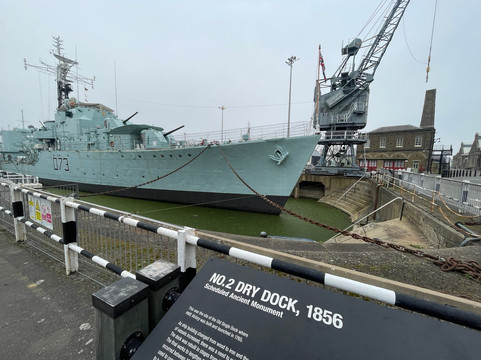
I then continued along the docks, I’m not interested really in submarines or modern battleships, what did catch my eye though was a plaque by No. 2 dry dock (now filled with water and housing the huge battleship HMS Cavalier) saying that this was the site of HMS Victory’s lauch in 1765)
She had also returned to this dockyard for repairs following the Battle of Trafalgar.
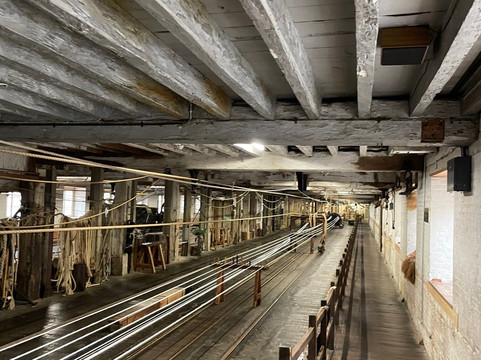
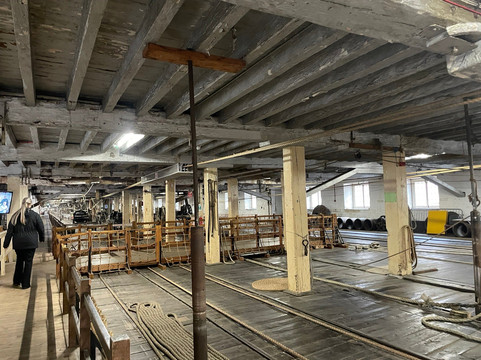
I then went to the ropery, the last surviving Royal Navy ropery in England, where I got a hands-on rope making experience.
The tour consisted of only the guide, myself and 1 other person. Which was fortunate as this was the minimum number of people required for making rope on the tour.
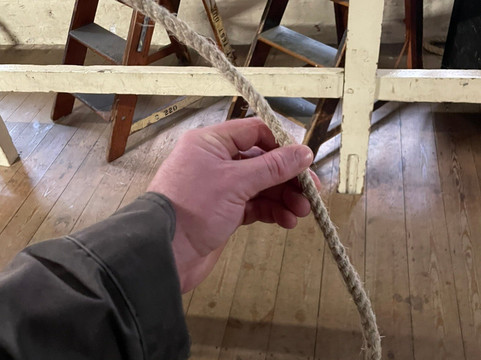
After talking us through the process of rope making, the guide got us on miniature versions of the equipment used to spin our own spunyarn and spin this into rope.
She then taped off several places and cut the rope (the idea being that if the rope did not try to unravel itself or spring about a lot it was good quality. Thankfully ours hit floor, rolled a little, but mostly stayed still)
She did not think to tell us before that it would be better quality rope if we worked sat the same pace, and I’m not entirely sure we did. Nevertheless, it turned out quite well.
She cut two lengths for each of us as souvenirs.
She then showed us the ‘ropewalk’ a quarter mile long building, still using its original Victorian equipment where the Master Ropemakers still create huge lengths of rope of all strengths and sizes to use commercially.
But it’s not the length of the building or the equipment that hits you first, its the strong smell of burning rope that fills the air, as I was told that, how was the practice 400 years ago when they started making rope, spunyarn here is still treated with hot tar to make it waterproof before spinning into rope.
I then went into the show ‘Hearts of Oak’, a show where you walk around several sets, across two floors of the building, guided by a projection of a man and his grandson as the former tries to convince the latter to follow in his footsteps and become a shipwright rather than a naval man.
I then returned to the hotel to relax (it was really hard work making that rope!)
Good timing too, it just started to rain.
Docked in Chatham as a permanent Museum exhibit since 1987 is HMS Gannet and the real reason I came today
The ship was amazing to see, a beautiful ship (the last surviving Doterel-class screw-driven sloop of the Victorian Navy)
Something about the ship did not look right to me though, a barque with only two masts is vet wrong, as well as having a rather shortened Spritboom.
There was a member of staff on board, and when I asked him about the ship he said ”I’m glad someone has finally noticed!”
He expalined that the foremast had been removed for restoration, pointing to where it had been laid down and partially covered under a tarpaulin further down the dock.
Also he said that the Spritboom had been retracted onto the bow for the same purpose.
It was still amazing to walk around the weather deck of the ship with the two remaining masts, the rigging and the steam funnels.
At the fore of the ship were stairs up to the fo’clse looking over the bowsprit.
Beneath the fo’csle is a storage room containing a single 64 pound cannon, an example of one of the armaments she carried.
At the aft were siimilar stairs to the poop deck (presumably this is a poop rather than a quaterdeck, as I believe that what makes a quarterdeck a quarterdeck is the presence of the ships wheel, which was located below. Any deck above the ships’ wheel therefore must be the poop?)
Under the poop deck was a large room (a great cabin), which presumably was for the captain of the ship.
Returning to the fore, there was a staircase behind the capstan going to the lower deck.
These stairs went down to a small room, about the same size as the fo’csle.
Besides plenty of information boards, there was practically nothing else here, and moving aft along a walkway on the starboard side, the steam pump machinery has been removed leaving a big empty space.
Beyond this was another room, equally devoid of everything except a few information boards and a staircase back up to the weather deck.
All the stairs on the ship were incredibly steep, almost vertical, and the steps were very narrow, so I took all of them very slowly and carefully. There were notices everywhere on the steps saying to go down facing the steps.
In HMS Victory I haddn’t followed this ruling as I cannot say it felt safe having my back to an empty room, if I fell backwards I would’ve landed with a crash onto my spine!
Similarly on the Matthew I haddn’t followed this, and had been called up by a crewman for going down the stairs then “in an unsafe manner”.
So obeying the rule now, I moved very slowly indeed!
The ship was interesting to see, it is unfortunate that below deck there was not much.
Returning to the dock, I went to see the foremast that had been removed for restoration.
I then continued along the docks, I’m not interested really in submarines or modern battleships, what did catch my eye though was a plaque by No. 2 dry dock (now filled with water and housing the huge battleship HMS Cavalier) saying that this was the site of HMS Victory’s lauch in 1765)
She had also returned to this dockyard for repairs following the Battle of Trafalgar.
I then went to the ropery, the last surviving Royal Navy ropery in England, where I got a hands-on rope making experience.
The tour consisted of only the guide, myself and 1 other person. Which was fortunate as this was the minimum number of people required for making rope on the tour.
After talking us through the process of rope making, the guide got us on miniature versions of the equipment used to spin our own spunyarn and spin this into rope.
She then taped off several places and cut the rope (the idea being that if the rope did not try to unravel itself or spring about a lot it was good quality. Thankfully ours hit floor, rolled a little, but mostly stayed still)
She did not think to tell us before that it would be better quality rope if we worked sat the same pace, and I’m not entirely sure we did. Nevertheless, it turned out quite well.
She cut two lengths for each of us as souvenirs.
She then showed us the ‘ropewalk’ a quarter mile long building, still using its original Victorian equipment where the Master Ropemakers still create huge lengths of rope of all strengths and sizes to use commercially.
But it’s not the length of the building or the equipment that hits you first, its the strong smell of burning rope that fills the air, as I was told that, how was the practice 400 years ago when they started making rope, spunyarn here is still treated with hot tar to make it waterproof before spinning into rope.
I then went into the show ‘Hearts of Oak’, a show where you walk around several sets, across two floors of the building, guided by a projection of a man and his grandson as the former tries to convince the latter to follow in his footsteps and become a shipwright rather than a naval man.
I then returned to the hotel to relax (it was really hard work making that rope!)
Good timing too, it just started to rain.
翻译:今天我去了查塔姆历史造船厂。
自1987年以来,HMS Gannet号一直作为永久博物馆展品停泊在查塔姆,这也是我今天来此的真正原因。
这艘船真是令人惊叹,一艘美丽的战舰(维多利亚时代海军最后一艘幸存的Doterel级螺旋桨单桅帆船)。
不过,这艘船总让我觉得哪里不太对劲。一艘只有两根桅杆的帆船实在是不合常理,而且它的斜桁也显得过短。
船上有一位工作人员,当我问起这艘船时,他说:“很高兴终于有人注意到了!”
他解释说,前桅杆已被拆除进行修复,并指着船坞更远处被帆布部分覆盖的桅杆所在位置。
他还说,斜桁也为了同样的目的被收回到了船首。
漫步在甲板上,看着仅存的两根桅杆、索具和烟囱,依然令人惊叹。
船首有通往前甲板的楼梯,可以俯瞰船首斜桅。
前甲板下方是一个储藏室,里面存放着一门64磅炮,这是该船装备的武器之一。
船尾也有类似的楼梯通往艉甲板(这里应该是艉甲板而不是后甲板,因为我认为后甲板的标志是船舵,而船舵位于艉甲板下方。因此,船舵上方的任何甲板都应该是艉甲板吧?)。
艉甲板下方是一个大房间(一个豪华的船舱),大概是船长的住所。
回到船首,绞盘后面有一条通往下层甲板的楼梯。
这些楼梯通往一个小房间,大小和前甲板差不多。
除了大量的信息板,这里几乎什么都没有。沿着右舷的走道向船尾走去,蒸汽泵的机械装置已被拆除,留下了一大片空地。
再往前走是另一个房间,同样空空荡荡,只有几块信息板和通往露天甲板的楼梯。
船上的所有楼梯都非常陡峭,几乎垂直,而且台阶很窄,所以我走的时候都非常缓慢小心。台阶上到处都贴着告示,说要面向台阶走下。
在“胜利”号上,我没有遵守这条规定,因为背对着空房间感觉不太安全,如果我向后摔倒,肯定会重重地摔在脊椎上!
同样,在“马修”号上,我也没有遵守这条规定,结果被一名船员叫去,说我“下楼梯的方式不安全”。
所以,我遵守规则,走得非常慢!
这艘船很有意思,可惜甲板下没什么可看的。
回到码头后,我去看了被拆下来修复的前桅杆。
然后我继续沿着码头走,我对潜艇或现代战舰其实没什么兴趣,不过2号干船坞(现在注满了水,停泊着巨大的战列舰“骑士”号)旁的一块牌匾吸引了我的目光,上面写着这里是“胜利”号战列舰1765年的下水地。
特拉法加海战后,“胜利”号也曾回到这个船坞进行维修。
之后,我去了绳索作坊,这是英国现存的最后一家皇家海军绳索作坊,在那里我亲手体验了绳索制作。
参观团只有导游、我和另一位游客。这真是太好了,因为这是绳索制作参观团所需的最低人数。
导游向我们讲解了绳索制作的全过程后,带我们体验了纺纱设备的微缩模型,并亲手将纱线纺成绳索。
随后,她用胶带标记出几个位置,然后剪断绳索(她的想法是,如果绳索不会自行散开或过度弹跳,就说明质量好。谢天谢地,我们的绳索落地后滚动了几圈,但大部分时间都保持静止)。
她之前没有告诉我们,如果我们坐着以相同的速度工作,绳索的质量会更好,我也不确定我们是否真的做到了。不过,最终的成品还不错。
她给我们每人剪了两段绳索作为纪念品。
之后,她带我们参观了“绳索作坊”,这是一座长达四分之一英里的建筑,至今仍使用着维多利亚时代的原始设备,绳索大师们在这里制作各种强度和尺寸的大型绳索,用于商业用途。
但最先冲击你的并非建筑的规模或设备,而是空气中弥漫的浓烈绳索燃烧气味。有人告诉我,400年前人们开始制绳时,这里仍然保留着用热焦油处理纱线使其防水,然后再纺成绳索的传统做法。
之后,我去看了名为“橡树之心”的展览。在这个展览中,观众会在两层楼的多个场景中穿梭,投影会引导观众看到一位老人和他的孙子。老人试图说服孙子继承他的事业,成为一名造船工匠,而不是一名海军士兵。
之后,我回到酒店休息(制作绳索真是个体力活!)。
时机也正好,刚开始下雨。
自1987年以来,HMS Gannet号一直作为永久博物馆展品停泊在查塔姆,这也是我今天来此的真正原因。
这艘船真是令人惊叹,一艘美丽的战舰(维多利亚时代海军最后一艘幸存的Doterel级螺旋桨单桅帆船)。
不过,这艘船总让我觉得哪里不太对劲。一艘只有两根桅杆的帆船实在是不合常理,而且它的斜桁也显得过短。
船上有一位工作人员,当我问起这艘船时,他说:“很高兴终于有人注意到了!”
他解释说,前桅杆已被拆除进行修复,并指着船坞更远处被帆布部分覆盖的桅杆所在位置。
他还说,斜桁也为了同样的目的被收回到了船首。
漫步在甲板上,看着仅存的两根桅杆、索具和烟囱,依然令人惊叹。
船首有通往前甲板的楼梯,可以俯瞰船首斜桅。
前甲板下方是一个储藏室,里面存放着一门64磅炮,这是该船装备的武器之一。
船尾也有类似的楼梯通往艉甲板(这里应该是艉甲板而不是后甲板,因为我认为后甲板的标志是船舵,而船舵位于艉甲板下方。因此,船舵上方的任何甲板都应该是艉甲板吧?)。
艉甲板下方是一个大房间(一个豪华的船舱),大概是船长的住所。
回到船首,绞盘后面有一条通往下层甲板的楼梯。
这些楼梯通往一个小房间,大小和前甲板差不多。
除了大量的信息板,这里几乎什么都没有。沿着右舷的走道向船尾走去,蒸汽泵的机械装置已被拆除,留下了一大片空地。
再往前走是另一个房间,同样空空荡荡,只有几块信息板和通往露天甲板的楼梯。
船上的所有楼梯都非常陡峭,几乎垂直,而且台阶很窄,所以我走的时候都非常缓慢小心。台阶上到处都贴着告示,说要面向台阶走下。
在“胜利”号上,我没有遵守这条规定,因为背对着空房间感觉不太安全,如果我向后摔倒,肯定会重重地摔在脊椎上!
同样,在“马修”号上,我也没有遵守这条规定,结果被一名船员叫去,说我“下楼梯的方式不安全”。
所以,我遵守规则,走得非常慢!
这艘船很有意思,可惜甲板下没什么可看的。
回到码头后,我去看了被拆下来修复的前桅杆。
然后我继续沿着码头走,我对潜艇或现代战舰其实没什么兴趣,不过2号干船坞(现在注满了水,停泊着巨大的战列舰“骑士”号)旁的一块牌匾吸引了我的目光,上面写着这里是“胜利”号战列舰1765年的下水地。
特拉法加海战后,“胜利”号也曾回到这个船坞进行维修。
之后,我去了绳索作坊,这是英国现存的最后一家皇家海军绳索作坊,在那里我亲手体验了绳索制作。
参观团只有导游、我和另一位游客。这真是太好了,因为这是绳索制作参观团所需的最低人数。
导游向我们讲解了绳索制作的全过程后,带我们体验了纺纱设备的微缩模型,并亲手将纱线纺成绳索。
随后,她用胶带标记出几个位置,然后剪断绳索(她的想法是,如果绳索不会自行散开或过度弹跳,就说明质量好。谢天谢地,我们的绳索落地后滚动了几圈,但大部分时间都保持静止)。
她之前没有告诉我们,如果我们坐着以相同的速度工作,绳索的质量会更好,我也不确定我们是否真的做到了。不过,最终的成品还不错。
她给我们每人剪了两段绳索作为纪念品。
之后,她带我们参观了“绳索作坊”,这是一座长达四分之一英里的建筑,至今仍使用着维多利亚时代的原始设备,绳索大师们在这里制作各种强度和尺寸的大型绳索,用于商业用途。
但最先冲击你的并非建筑的规模或设备,而是空气中弥漫的浓烈绳索燃烧气味。有人告诉我,400年前人们开始制绳时,这里仍然保留着用热焦油处理纱线使其防水,然后再纺成绳索的传统做法。
之后,我去看了名为“橡树之心”的展览。在这个展览中,观众会在两层楼的多个场景中穿梭,投影会引导观众看到一位老人和他的孙子。老人试图说服孙子继承他的事业,成为一名造船工匠,而不是一名海军士兵。
之后,我回到酒店休息(制作绳索真是个体力活!)。
时机也正好,刚开始下雨。
© 2026 Tripadvisor 版权所有。
部分照片由 VFM Leonardo 提供。
TripAdvisor公司对外部网站的内容一概不负责。优惠价格中不含税和其他费用。
ICP证:沪B2-20200433
沪ICP备20013175号
 沪公网安备31010502005427号
鹰程信息技术(上海)有限公司