下载App
资质规则
旅行
账户
Brun066
A monumental complex extraordinarily interesting, for both artistic, archaeological, and religious reasons.
Basilica of Saint Christina的点评
点评:The Church of Santa Cristina features its Renaissance gray stone façade at the end of a yard in the heart of Bolsena. It offers several points of interest, linked to the tradition of the saint of the same name (who is said to have lived between the third and fourth centuries AD), her burial (rediscovered only in 1880 in the part of the catacombs where she had been walled up), the vast complex of catacombs themselves extending beneath the hill to the left of the church, and finally the so-called Miracle of Bolsena in 1263, which, among other things, led to the construction of the gorgeous cathedral in nearby Orvieto.
The church is free to visit, and visitors can appreciate its three Romanesque naves (the church was consecrated by Pope Gregory VII in 1077), with columns partly reused from Roman buildings. Visitors can also enter the atrium of the Baroque-style "Chapel of the Miracle". To continue further, to the so-called "Grotta di Santa Cristina" and the catacombs, you must pay an entrance fee (6 euros) on site, but it's well worth it.
Into the Grotta, the so-called altar of Santa Cristina is surmounted by an evocative, valuable ciborium from the 9th century (so previous to the church). The altar frontal is made from the block of basalt that, when tied to Cristina as she was thrown into the Bolsena lake, is said to have supported her instead of dragging her to the bottom.
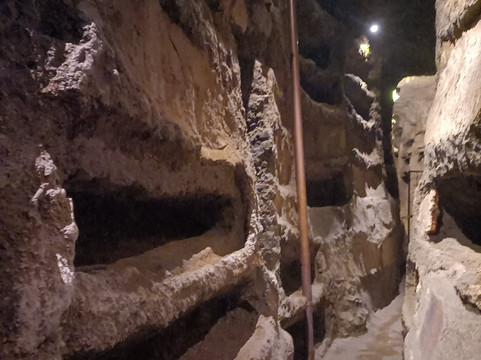
Continuing toward the entrance to the catacombs, you come across the Roman sarcophagus that contained the remains of the saint, but not all of them: when they were discovered, her long bones were missing, stolen at an unknown time. Finally, a curved staircase leads to the catacombs, which are quite large and branched out in the typical "tree" shape, ie with shorter branches the further you get from the entrance.
Overall, it's a monumental complex of extraordinary interest.
The church is free to visit, and visitors can appreciate its three Romanesque naves (the church was consecrated by Pope Gregory VII in 1077), with columns partly reused from Roman buildings. Visitors can also enter the atrium of the Baroque-style "Chapel of the Miracle". To continue further, to the so-called "Grotta di Santa Cristina" and the catacombs, you must pay an entrance fee (6 euros) on site, but it's well worth it.
Into the Grotta, the so-called altar of Santa Cristina is surmounted by an evocative, valuable ciborium from the 9th century (so previous to the church). The altar frontal is made from the block of basalt that, when tied to Cristina as she was thrown into the Bolsena lake, is said to have supported her instead of dragging her to the bottom.
Continuing toward the entrance to the catacombs, you come across the Roman sarcophagus that contained the remains of the saint, but not all of them: when they were discovered, her long bones were missing, stolen at an unknown time. Finally, a curved staircase leads to the catacombs, which are quite large and branched out in the typical "tree" shape, ie with shorter branches the further you get from the entrance.
Overall, it's a monumental complex of extraordinary interest.
翻译:圣克里斯蒂娜教堂位于博尔塞纳市中心,坐落于一个庭院的尽头,其文艺复兴时期的灰色石砌外墙引人注目。教堂本身也拥有诸多值得一看的景点,这些景点与同名圣人(据称生活于公元三至四世纪)的传说、她的墓葬(直到1880年才在她被封堵的地下墓穴中被重新发现)、教堂左侧山丘下绵延的庞大地下墓穴群,以及1263年发生的所谓“博尔塞纳奇迹”息息相关。正是这一奇迹促成了附近奥尔维耶托宏伟的大教堂的建造。
教堂免费开放参观,游客可以欣赏其三座罗马式中殿(教堂于1077年由教皇格里高利七世祝圣),部分柱子取自罗马建筑。游客还可以进入巴洛克风格的“奇迹小堂”的中庭。继续前行,前往所谓的“圣克里斯蒂娜洞穴”(Grotta di Santa Cristina)和地下墓穴,需要现场支付门票(6欧元),但绝对物有所值。
进入洞穴,圣克里斯蒂娜祭坛上方摆放着一个令人难忘的珍贵圣体龛,其历史可追溯至9世纪(早于教堂的建造)。祭坛正面由一块玄武岩石制成,据说当克里斯蒂娜被扔进博尔塞纳湖时,这块岩石支撑着她,而不是将她拖入湖底。
继续前行,前往地下墓穴入口,你会看到存放圣人遗骸的罗马石棺,但并非全部遗骸:当石棺被发现时,她的长骨已经不见了,不知何时被盗。最后,一条弧形楼梯通往地下墓穴,墓穴规模宏大,呈典型的“树状”分支,即离入口越远,分支越短。总而言之,这是一个规模宏大、极具研究价值的建筑群。
教堂免费开放参观,游客可以欣赏其三座罗马式中殿(教堂于1077年由教皇格里高利七世祝圣),部分柱子取自罗马建筑。游客还可以进入巴洛克风格的“奇迹小堂”的中庭。继续前行,前往所谓的“圣克里斯蒂娜洞穴”(Grotta di Santa Cristina)和地下墓穴,需要现场支付门票(6欧元),但绝对物有所值。
进入洞穴,圣克里斯蒂娜祭坛上方摆放着一个令人难忘的珍贵圣体龛,其历史可追溯至9世纪(早于教堂的建造)。祭坛正面由一块玄武岩石制成,据说当克里斯蒂娜被扔进博尔塞纳湖时,这块岩石支撑着她,而不是将她拖入湖底。
继续前行,前往地下墓穴入口,你会看到存放圣人遗骸的罗马石棺,但并非全部遗骸:当石棺被发现时,她的长骨已经不见了,不知何时被盗。最后,一条弧形楼梯通往地下墓穴,墓穴规模宏大,呈典型的“树状”分支,即离入口越远,分支越短。总而言之,这是一个规模宏大、极具研究价值的建筑群。

© 2026 Tripadvisor 版权所有。
部分照片由 VFM Leonardo 提供。
TripAdvisor公司对外部网站的内容一概不负责。优惠价格中不含税和其他费用。
ICP证:沪B2-20200433
沪ICP备20013175号
 沪公网安备31010502005427号
鹰程信息技术(上海)有限公司