下载App
资质规则
旅行
账户

VadimM67
The quintessence of the Baroque.
人鱼喷泉的点评
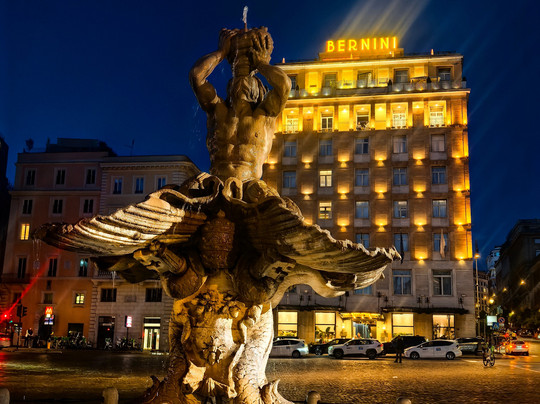
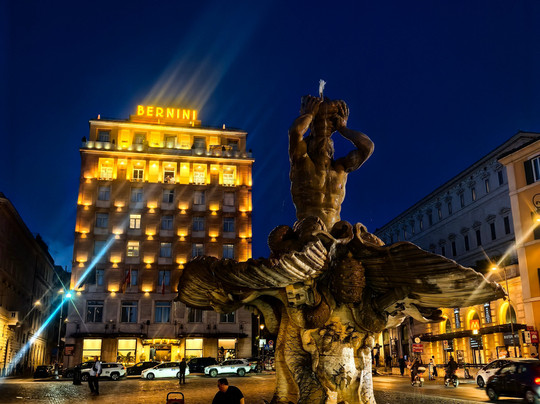
点评:The FontanTriton in Piazza Barberini is one of the must-haves for those who watch Bernini's masterpieces in Rome. This is already the creation of a mature Bernini, in a sense, a return to the roots, because at the age of 25 he made "Neptune and Triton". However, not for the fountain. Although art historians believe that Bernini borrowed the motifs of the fountain from Stefano Maderno's Aquila fountain in the Vatican, and the dolphin motif from another Vatican fountain, but synthesis is not a summation of components! The fountain's originality lies in the fact that Bernini did not rely either on the obelisk, as his predecessors did in the fountain in Piazza Rotonda, or on the wall, as in Aqua Felice or Aqua Paola. He transferred the load-bearing load to a group of dolphins, thereby giving dynamism to the figure of the Newt. The expression is enhanced by the powerful torso, upraised arms and the tilted back head of Poseidon's son. Who, like Bernini, knew how to animate marble sculptures? It is the quintessence of the Baroque. That's why we love him. At the bottom, you can see bees, the symbol of the Barberini family, whose representative, Pope Urban VIII, was the customer of the fountain. Logos, it turns out, were already practiced in the 17th century...
翻译:巴贝里尼广场的特里同喷泉是罗马艺术爱好者欣赏贝尼尼杰作的必游之地。从某种意义上说,这件作品已是贝尼尼成熟时期的代表作,也算是回归本源之作,因为他在25岁时就创作了《海神尼普顿与特里同》。然而,这件作品并非贝尼尼为这座喷泉所作。尽管艺术史学家认为贝尼尼借鉴了梵蒂冈圣马德尔诺设计的鹰形喷泉的元素,以及另一座梵蒂冈喷泉的海豚图案,但综合并非简单的元素叠加!这座喷泉的独创性在于,贝尼尼既没有像罗通达广场喷泉那样依赖方尖碑,也没有像费利切水池或保拉水池那样依赖墙体。他将承重转移到一群海豚身上,从而赋予了海神尼普顿的形象以动感。波塞冬之子那健硕的躯干、高举的双臂和微微后仰的头部,更凸显了雕塑的神韵。还有谁能像贝尼尼一样,如此精妙地赋予大理石雕塑以生命?这正是巴洛克艺术的精髓所在。这也是我们如此喜爱他的原因。雕塑底部饰以蜜蜂,这是巴贝里尼家族的象征,而该家族的代表人物——教皇乌尔班八世——正是这座喷泉的委托人。原来,早在17世纪,人们就已经运用了标志设计……

© 2026 Tripadvisor 版权所有。
部分照片由 VFM Leonardo 提供。
TripAdvisor公司对外部网站的内容一概不负责。优惠价格中不含税和其他费用。
ICP证:沪B2-20200433
沪ICP备20013175号
 沪公网安备31010502005427号
鹰程信息技术(上海)有限公司