下载App
资质规则
旅行
账户

Tripadvisor用户
Old Madrid
Casa de la Villa的点评
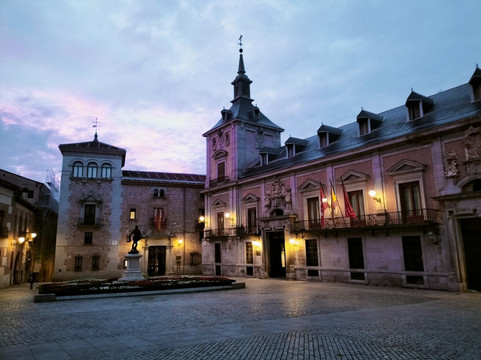
点评:Plaza de la Villa was one of the main centres of medieval Madrid because of its location halfway between the Ports of Guadalajara and the Vega, two of the major entrances to the city during the Middle Ages. In the fifteenth century, Plaza de la Villa adopted its current name, coinciding with the granting of the title of "Noble and Loyal", received by Madrid by King Enrique IV of Spain (1425-1474).
The named Casa de la Villa occupies the former site of the houses of the Marquis del Valle, Mr. Juan de Acuña, where the Duke of Osuna lived (1574-1624) when, the Holy Thursday of 1621, he was taken prisoner by order of the king. Despite the different views, it is considered that its construction began around 1645, from a design by the architect Juan Gómez de Mora, and was completed in 1693. The gallery of Tuscan columns on the façade facing the calle Mayor is the work of Juan de Villanueva (1789).
From the date of completion of works it was the home of Madrid City Hall until, on November 5, 2007, the Mayor of Madrid moved to the Cibeles Palace, leaving this building reserved almost exclusively by the Municipal Council.
The named Casa de la Villa occupies the former site of the houses of the Marquis del Valle, Mr. Juan de Acuña, where the Duke of Osuna lived (1574-1624) when, the Holy Thursday of 1621, he was taken prisoner by order of the king. Despite the different views, it is considered that its construction began around 1645, from a design by the architect Juan Gómez de Mora, and was completed in 1693. The gallery of Tuscan columns on the façade facing the calle Mayor is the work of Juan de Villanueva (1789).
From the date of completion of works it was the home of Madrid City Hall until, on November 5, 2007, the Mayor of Madrid moved to the Cibeles Palace, leaving this building reserved almost exclusively by the Municipal Council.
翻译:马德里广场(Plaza de la Villa)是中世纪马德里的主要中心之一,因为它位于瓜达拉哈拉港和维加港之间,这两个港口是中世纪时期进入马德里的主要入口。十五世纪,马德里广场正式更名为现名,这与西班牙国王恩里克四世(1425-1474 年在位)授予马德里“高贵忠诚之城”的称号不谋而合。
如今的马德里别墅(Casa de la Villa)位于胡安·德·阿库尼亚侯爵(Marquis del Valle)的故居旧址上,奥苏纳公爵(1574-1624 年在位)曾居住于此。1621 年的圣周四,他奉国王之命在此被捕。尽管众说纷纭,但普遍认为其始建于1645年左右,由建筑师胡安·戈麦斯·德·莫拉设计,并于1693年竣工。面向马约尔街的立面上的托斯卡纳柱廊是胡安·德·维拉努埃瓦于1789年的作品。
自竣工之日起,这里一直是马德里市政厅所在地,直到2007年11月5日马德里市长迁至西贝莱斯宫,此后这座建筑几乎完全由市政委员会使用。
如今的马德里别墅(Casa de la Villa)位于胡安·德·阿库尼亚侯爵(Marquis del Valle)的故居旧址上,奥苏纳公爵(1574-1624 年在位)曾居住于此。1621 年的圣周四,他奉国王之命在此被捕。尽管众说纷纭,但普遍认为其始建于1645年左右,由建筑师胡安·戈麦斯·德·莫拉设计,并于1693年竣工。面向马约尔街的立面上的托斯卡纳柱廊是胡安·德·维拉努埃瓦于1789年的作品。
自竣工之日起,这里一直是马德里市政厅所在地,直到2007年11月5日马德里市长迁至西贝莱斯宫,此后这座建筑几乎完全由市政委员会使用。

© 2026 Tripadvisor 版权所有。
部分照片由 VFM Leonardo 提供。
TripAdvisor公司对外部网站的内容一概不负责。优惠价格中不含税和其他费用。
ICP证:沪B2-20200433
沪ICP备20013175号
 沪公网安备31010502005427号
鹰程信息技术(上海)有限公司